


Introduction
LA County Shapes the Nation
Los Angeles County is one of the most visible and
culturally significant centers of Trans & Queer
(LGBTQIA2S+) life in the United States. From historic
activism to vibrant community networks, Los Angeles
County plays an important role in shaping Trans &
Queer visibility, human rights, and systemic justice.
Despite LA County’s reputation for progress, the
lived experiences of Trans & Queer individuals across
Los Angeles County reveal a more complex reality,
especially within the suburban region of the San
Gabriel Valley (SGV). While many Trans & Queer people
report increased social freedoms and community
connection, disparities in safety, health, and housing
continue. The largest segments of the Trans & Queer community significantly affected are people of color (POC), Transgender, Gender-expansive and Intersex (TGI) individuals, and those with lower incomes—and particularly those who simultaneously inhabit all three. These inequities are evident within the San Gabriel Valley and are an invitation to transform Trans& Queer suburban life.
Different Populations Require Tailored Resources
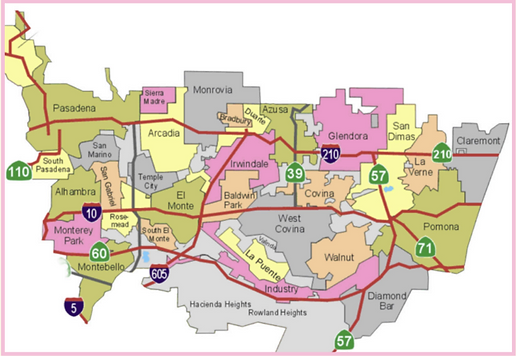
The San Gabriel Valley is a unique suburban region of Southern California with a population of 2 million and an estimated 120,000 Trans & Queer lives that call it home. With 20% of LA County’s LGBTQIA2S+ population, the SGV has the largest estimated population of Trans & Queer people in LA County with the least resources for Trans & Queer communities.
The SGV sits between the major cities of greater Los Angeles and the Inland Empire, composed of Riverside and San Bernardino County. Los Angeles County is divided into five Districts and the SGV represents three; the majority of District 1, some of District 5, and District 4 to incorporate the socially claimed city of Whittier. The SGV is 285 square miles with 31 incorporated cities and 5 unincorporated communities.
The SGV wants to Thrive at Home
This research is the first SGV-wide study of the health and safety needs of Trans & Queer people in the San Gabriel Valley. Although countywide data for Los Angeles County is available, it is not disaggregated, lacks this level of detail, and does not capture the specific knowledge and experiences of the SGV. Within the data, you will learn what many Trans & Queer San Gabrielinos know too well–the SGV is a resource desert for culturally, racially and linguistically relevant LGBTQIA2S+ services.
Each section of the report outlines community needs and priorities we must all adopt for the San Gabriel Valley. Our work brings to light what safety, access and care can be for Trans & Queer people in the SGV,
and how all sectors of leadership can do their part to improve it. We also elevate the TGI State of Emergency that lives within the SGV. Lastly, we honor the ways Trans & Queer people create community and different worlds among destruction.
As you learn about Trans & Queer people in the San Gabriel Valley, keep in mind that not all communities— particularly immigrants, people of color, and seniors– are comprehensively represented due to language and geography barriers. This report is the beginning of continued learning and investment in the nuanced Trans & Queer communities of the SGV. Much-needed attention to the region will build suburban power to ensure Trans & Queer SGV thrives at home!
Recommendations
Trans & Queer SGV Have a Clear Direction
Trans & Queer people know exactly what they need and want to see in their San Gabriel Valley. San Gabrielinos have a strong need and desire for resources, programs, visibility, safety and support to help Trans & Queer SGV thrive at home.
Be an Outspoken Ally & Proactive Accomplice
Trans & Queer SGV ask their allies to
1) be active in their education of LGBTQ+ issues,
2) be vocal about their support for Trans & Queer rights and
3) publicly intervene when harm is taking place.

Tailor Resources & Social Services
LGBTQ+ specific resources and services are needed for basic care & safety. Trans & Queer SGV are in need of tailored
1) health: LGBTQ+ clinics, STI testing, mental health services, health fairs and provider education,
2) employment: job fairs, career opportunities, LGBTQ+ workforce development and
3) legal services: advice and representation for immigration and discrimination cases.
Establish TGI Focused Care
Transgender, Gender-Expansive and Intersex people are in need of tailored
1) resources: emergency financial support, gender-affirming network and provider directory,
2) programs: mentorship, social events and sports leagues and
3) public life protections: gender-neutral public bathrooms and standard public safety practices in the San Gabriel Valley.
Grow Community Connections
Trans & Queer SGV asked for spaces to connect and create throughout the year over
1) events and socials: sober spaces, Pride celebrations, adult and youth LGBTQ+ sports,
2) reciprocal care: mutual aid networks and
3) LGBTQ+ specific spaces: community centers and services within city buildings.
Be Active in School Board & Government Decisions
School Boards: Protect Trans & Queer children. Enact district-wide policies for teachers administration & staff to uphold privacy, prevent bullying and defend inclusive restroom policies.
City, County & State Government: Trans & Queer SGV ask their government leaders to
1) proactively advance TGI and LGBTQ+ affirming policies, protections and investments year-round, 2) establish LGBTQ+ government departments and Chamber of Commerce and
3) engage strategies across all departments to create Trans & Queer-specific disaster relief, resources, networks and public website information.


“Our town [Altadena] burned, so everyone disappeared and are displaced. Felt the absence of government agencies reaching out to people in inclusive spaces. That makes it harder to find each other.”
- Survey Participant
Demographics
TGI Lives Are Active Participants in the San Gabriel Valley
Out of the 478 survey responses, almost half of all participants, 229 people at 47.9%, are Transgender, Gender-Expansive and Intersex (TGI) people that shared their lives within this research. The high percentage of TGI respondents in this study reflects the research team’s recruitment through community relationships and TGI-affirming outreach. TGI people are the gender and sex minorities of humanity, making their high participation a unique demographic quality about this study in the San Gabriel Valley.
TGI lives are represented within three categories in this study 1) TransFemme; Transgender Feminine, 2) Trans Masc; Transgender Masculine and 3) Gender-Expansive people. The Gender-Expansive category includes Intersex lives, the ‘I’ within the TGI acronym, as well as Agender, Non-binary, Genderqueer, Genderfluid and Two-Spirit people. In this research study, Gender-Expansive participants represented 31.7% (n = 152) of the survey sample, the largest group among gender categories. The second highest gender group was cisgender women at 29.7% (n = 142). Among the assigned sex at birth categories, 62.3% of participants (n = 298) were assigned female at birth, making this the largest group in the sample.
Access to Resource and Care
Experiences Are Shifting in the San Gabriel Valley
A common story, heard and told about growing up in the San Gabriel Valley, is that you have to travel to Los Angeles to receive healthcare and public services. The research team set out to determine whether this narrative is true today for Trans & Queer San Gabrielinos. Trans & Queer SGV compared their experience and resources to West Hollywood and Downtown Los Angeles areas within the survey and community discussions. West Hollywood and Downtown LA were recognized as places where buildings, services and funding are dedicated to intersectional Trans & Queer communities. The places and programs that meet the direct needs of Trans & Queer SGV are determined to grow. As services become available, participants expressed the importance of tailoring to the needs of Trans & Queer Black, Indigenous People of Color (BIPOC) and linguistic relevance with ease of access.
Delaying Care Is Also a Preservation Practice
Engaging with public resources and healthcare is additionally difficult for Trans & Queer people. In the last year, a quarter of participants (25.1%) delayed care over concerns of being disrespected or mistreated as a Trans or Queer person. Delayed care can be misunderstood as an individual matter of avoidance or low desire. With a clear awareness of the experiences they are highly likely to encounter, Trans & Queer people determine their engagement with public resources and healthcare based on these lived experiences and matched protections to confront them. Among Trans & Queer people, this behavior may be better understood as a type of self-promotion or self-preservation practice as systems of care and safety fail and target them directly.
Trans & Queer SGV Call Out to City Leadership For Action
Political systems of support, such as County, City, School Board and business leadership, are necessary to increase access to resources and services of care. Across the survey sample, satisfaction with city services, resources, and programs for Trans & Queer communities was low to moderate, with an average rating of 2.65 on a 5-point scale and a median of 3. Of SGV cities with more than 10 survey participants, Pasadena had the highest satisfaction scores, with 36.6% of participants rating their satisfaction as a 4 or a 5. This was followed by Baldwin Park (29.4%), Altadena (26.7%), El Monte (21.9%), and Monterey Park (17.6%)
Personal and Community Safety
In all six focus groups—TransFemmes, TransMascs, Transitional-Age Youth, Seniors, Immigrants and Loved Ones—community members discussed and grappled with the need to live with authenticity and safety, which for many are mutually exclusive. The Transitional-Age Youth focus group, ages 18-26 years old, explicitly shared that the San Gabriel Valley does not feel like a safe place for Trans & Queer people. One participant said they felt forced to leave the SGV to find community because “even just going to a park or walking around [here] is nerve-wracking.” The survey responses echoed this concern over safety. Although the survey did not ask whether violence occurred in the SGV specifically, nearly half of participants (44.6%) reported experiencing violence due to their gender and/or sexuality in the past 2 years. The violence they experienced includes cyberbullying, physical abuse or attacks, property damage, and verbal abuse or insults.

The most commonly reported type of identity-related harm was verbal abuse, experienced by approximately 38% of participants in the past two years. Cyberbullying was the second most reported type of identity-related harm, experienced by about 19% of participants in the past two years, showing that online settings can also be a hostile environment for Trans & Queer people. Some participants experienced more than one type of harm, which is reflected in the sum of percentages.
TGI State of Emergency
TGI SGV Lives Are in a Basics Needs Crisis
Within the San Gabriel Valley, TGI participants are living under a crisis for basic needs. All participants were asked to rate how stable their housing, food, and employment situations were: ‘very stable,’ ‘fairly stable,’ ‘somewhat stable,’ ‘fairly unstable,’ or ‘very unstable.’ Across all three basic needs categories, TGI participants had the lowest rates of ‘very stable’ situations, while cisgender men had the highest rates.
The Biggest Barriers are Insurance Companies and Healthcare Providers
When asked about the barriers encountered in accessing gender-affirming care, by far the most common answers were related to healthcare providers and insurance or cost.
Medical Transphobia Against Gender-Expansive Lives Was a Common Theme
Non-binary or Gender-Expansive people are people who exist within, outside of or throughout a gender binary. Participants named that being non-binary or Gender-Expansive was a source of increased difficulty in accessing gender-affirming care; they had to prove to healthcare providers and insurance companies that they are “trans enough” to receive care. Having to prove that one is “trans enough” to receive care is a particular type of transphobia wherein disbelief or distrust of patients
guides medical decision-making.
TGI Disability and Barriers in the SGV
Gender-Expansive participants reported the highest percentages of disability and health barriers to daily life and building community. 40.1% of Gender Expansive people expressed difficulty concentrating, remembering, or making decisions; 33.6% experience strong emotions and feelings interfering with daily activities; and 31.6% have a disability or long-term medical condition.
In contrast, the overall survey sample which included all participants, not separated by gender, revealed that 25.1% have difficulty concentrating, remembering, or making decisions; 24.3% experience strong emotions and feelings interfering with daily activities; and 22.8% have a disability or long-term medical condition.
Creating Community
Trans & Queer People want Different Kinds of Connections
Creating a community in the San Gabriel Valley is not a one-size-fits-all experience. A community is a system of support; reciprocal care and safety among trusted people and groups. There are various ways Trans & Queer people want to connect with others to experience life in the SGV. While some want to connect openly with other Trans & Queer people around shared issues and impact, others are trying to create through day to day activities and interests, such as Trans & Queer sports leagues, nature outings, and walking clubs.
Community Continues in Public & Private Places
Trans & Queer communities have historically established their own tailored spaces of care and connection; often as a response to exclusion or banishment. The top four places where respondents reported communities were 1) Queer Bars and Clubs, 2) Virtual Spaces, 3) Queer Parties and 4) in their personal home or friend’s homes. Queer Bars and Clubs are scarce in the San Gabriel Valley.
Safety is a Concern in Creating Trans & Queer Community
Among Trans & Queer study participants, there wasn’t an overall sense of where people could go and always be welcomed, aside from specific Trans & Queer places or designated nights. When Trans & Queer people do gather, participants named a sense of danger in being visible. For Seniors, who experienced violence, imprisonment, destroyed careers and generational deaths as publicly Out, they disclosed the genuine concern that visibility made them vulnerable targets and threatened their safety. Similar threats and dangers are being re-lived by Trans & Queer youth in the SGV.
Local Support is Found Between Cities and Neighborhoods
Trans & Queer people in the SGV want and are looking to find supportive communities at home. Every focus group elevated the importance of places and events that bring the SGV together and assure Trans & Queer people can thrive at home. For most participants, both in the survey and focus groups, it was clear that if the resources and communities existed, they would stay closer to home.
Acknowledgments From The Center
The San Gabriel Valley LGBTQ Center has a 15-year history of providing local programs, events, and campaigns for LGBTQIA2S+ people across SPA3 of Los Angeles County. The Center utilizes community-informed research to embolden advocacy & programs through initiatives and campaigns. We recognize this moment is difficult for the estimated 120,000+ Trans & Queer individuals that live, work and play in the San Gabriel Valley. In an ever-changing world, cultivating homegrown Pride for suburban Trans & Queer communities everywhere will foster advocacy, education and respect for our communities.
In 2022, through the La Puente Queer & Trans Action Ad-Hoc committee, we launched a pre-survey in the cities of Pasadena, Monterey Park, Alhambra, Baldwin Park and La Puente that emboldened the start of the SGV Pride Roundtable. City Council members, Mayors, and Regional Community Leaders nurtured cross-coalition building, and multiracial spaces that speak to equity, access, diversity, social justice, safety, mutual appreciation, empowerment and respect for all. In a season marked by uncertainty, hatred and violence, the collective responsibility for Trans and Queer dignity & equity must matter to all of us.
Through my time with the Center, I have seen up close the beauty of community in the San Gabriel Valley. The work of the SGV LGBTQ Center continues to instill homegrown Pride and bring visibility to suburban communities so Trans & Queer people can thrive at home. This research project is the first of its kind in the San Gabriel Valley and a gift for Trans & Queer people by Trans & Queer people.
The Trans & Queer Voices of the SGV Community Research Study is our collective proudest achievement. My greatest appreciation for the Trans & Queer Voices of the SGV research study goes to the inaugural staff: Julien De Jesus, Community Researcher; Zainab Hasan, Community Researcher; and our partnership with Héctor Trinidad Plascencia of Plascencia Consulting, for whom none of the past five years would be possible. From scaling the 2023 San Gabriel Valley Pride Tour to the inaugural State of Queer & Trans Pride in the SGV, Research Justice leads to transformation when led by an amazing team.
A huge Thank You to our partners at the Pasadena Public Health Department: Michael Oshiro, Melany Chan, Matthew Feaster, PhD. Our partner Raynald Samoa, MD with City of Hope. A very special thank you to our research team VolunQueers Michelle Angela Bicol, Justin Alamo, Minh Huynh, Alex Berrie, and Ryan Chiriboga who supported every step of the process.
We are grateful to the California Department of Public Health’s Office of Health Equity for providing a home for this work to live and to the advocates that made the state research grant possible. With this opportunity, we have a deeper understanding of our communities’ wants and needs in the San Gabriel Valley. I want to acknowledge Kristin Millikan for supporting us through this two year project and guiding us through all phases of the work.
Lastly, thank you to our Trans & Queer communities in the San Gabriel Valley for participating in one way or another in this study. Whether you took the survey, participated in a focus group, or shared the project with a friend, your contribution to this work helps transform what the SGV can be for Trans & Queer people, now and in the future.
This study and the research findings are meant to bring to light the experiences of Trans & Queer people in the suburbs of Los Angeles County and open the door for the SGV transformation from Resource Desert to Resource Oasis.